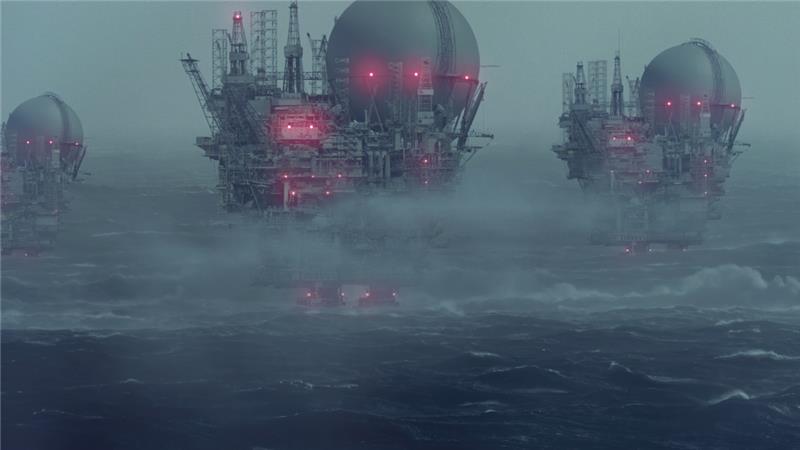
Liam Young, The Great Endeavour, 2023, video still. Courtesy the artist.
Planetary Futures and Artificial Intelligence
Tuesday, 16 September 2025 · 6:30 - 8:00 PM
As artificial intelligence (AI) becomes increasingly embedded in the systems that shape our world, its growing environmental impact cannot be ignored. This lecture brings into focus the often-overlooked environmental costs of AI: the vast energy consumption required to train and operate large-scale models, the expanding carbon footprint of data centres, and broader planetary implications. In this critical conversation, speculative architect and filmmaker Liam Young draws from his recent work The Great Endeavour (2023) in which he presents his vision of infrastructures capable of removing atmospheric CO₂ at scale. Framing climate mitigation as a monumental design challenge, his film imagines the largest machines ever conceived, inviting us to think in planetary terms and confront the climate crisis not just as a technical problem but a deeply imaginative one. In dialogue with him is Professor Bo An, whose research under the CTP provides advances in machine-learning approaches for climate science. Responding to these lectures, Kathleen Ditzig, Curator at National Gallery Singapore, will comment on the environmental politics of machine learning. This lecture will begin with a welcome address by Honor Harger, Director of ArtScience Museum, and moderated by Professor Ute Meta Bauer, this lecture brings together speculative design and cutting-edge AI research, inviting us to examine the environmental costs of intelligence and imagine sustainable futures.
Tuesday Lecture
16 September 2025
6:30pm – 8:00pm
The Hall, NTU CCA Singapore
Free with Registration
Register here
The Climate Transformation: Sustainable Societies Series is organised by members of the Climate Transformation Programme (CTP) Cross-Cutting Theme 1: Sustainable Societies research team, Senior Principal Investigator Professor Ute Meta Bauer, research fellow Joshua Vince Gebert, research associate Ng Mei Jia and research assistant Angela Ricasio Hoten.
Sustainable Societies
Senior Principal Investigator, Professor Ute Meta Bauer (NTU ADM)
Principal Investigator, Associate Professor Laura Miotto (NTU ADM)
Principal Investigator, Professor Dr Thomas Schroepfer (SUTD)
This Lecture Series is supported by the Singapore Ministry of Education Academic Research Fund Tier 3 grant [MOE-MOET32022-0006] for the Climate Transformation Programme.
Speakers
Liam Young
Liam Young is a speculative architect, production designer and director operating in the spaces between design, fiction and futures on a planetary scale. The image and footage for his propositional earthscapes build upon the research of his nomadic studio, Unknown Fields, which documents the impact extractive processes have on far-flung lands – from Madagascar sapphire pits to Amazonian oil fields, often with the help of autonomous drones or remote sensing technologies. Young is an educator and author as well and currently directs the master’s in fiction and entertainment at the Southern California Institute of Architecture (SCI-Arc) in Los Angeles. Young has held guest professorships at Princeton University, Massachusetts Institute of Technology, and University of Cambridge. His published writing includes Machine Landscapes: Architectures of the Post-Anthropocene (Wiley, 2019) and Planet City (Uro Publications, 2021). Young co-curated the exhibition Another World is Possible with the ArtScience Museum, Singapore exhibiting from 13 September 2025 to 22 February 2026.
Professor Bo An
Bo An is a Professor at the College of Computing & Data Science, and Co-Director of Artificial Intelligence Research Institute (AI.R) at Nanyang Technological University, Singapore. He is also a Principal Investigator for the Artificial Intelligence cross-cutting research cluster under the Climate Transformation Programme led by the Earth Observatory of Singapore. He received his PhD in Computer Science from the University of Massachusetts, Amherst. His current research interests include artificial intelligence, multiagent systems, computational game theory, reinforcement learning, and optimization.
Respondent
Kathleen Ditzig is an art historian and curator. She has written about global histories of culture, finance, and geopolitics through the lens of Southeast Asian Modern and Contemporary art. As a curator at National Gallery Singapore, she researches art histories of technology from a Southeast Asian perspective and works on projects related to advanced technologies. She received her PhD from the Nanyang Technological University in Singapore in 2023 and obtained her MA from the Center for Curatorial Studies, Bard College in New York in 2015.
Moderator
Ute Meta Bauer is a Professor at the School of Art, Design and Media, Nanyang Technological University Singapore (NTU), and Acting Director and Principal Research Fellow at the NTU Centre for Contemporary Art Singapore (NTU CCA Singapore). Having served as the Founding Director of NTU CCA Singapore for over a decade, her work as educator and curator over the past years has focused on Climates. Habitats. Environments. Her current research projects include Climate Transformation Programme: Sustainable Societies Research Cluster (2024–Present), Developing and Evaluating Digital Tools for Participatory Climate Change Mitigation (2025–Present) and previously, Climate Crisis and Cultural Loss (2021–2024), Environmentally-Engaged Artistic Practices in South, Southeast Asia and the Pacific (2021–2023), and Understanding Southeast Asia as a ‘Geocultural’ Formation (2021–2023).
Welcome Address
Honor Harger is a curator and director of ArtScience Museum in Singapore. Since she joined, the museum has presented significant exhibitions that explore aspects of science including big data, particle physics, natural history, marine biology, cosmology and space exploration. Before joining ArtScience Museum, Harger was the director of Lighthouse, a digital arts venue in Brighton, UK. In 2010, she was guest curator of the transmediale festival in Berlin, and from 2004 to 2008, she was director of the AV Festival, then the UK’s largest biennial of digital art, film and music. She was the first curator of webcasting for Tate, where she also curated events and concerts at Tate Modern.
About the Climate Transformation: Sustainable Societies Lecture Series
The series returns for its second cycle in the Academic Year 2025-26. Each session features researchers from the Climate Transformation Programme, alongside contributors from other academic fields, as well as artists, architects and advocates. In this second iteration, the lecture series is framed with policy relevance in mind, with respondents from various government agencies, non-governmental organisations, and other relevant industries offering immediate commentary.